Microbial products for aquaculture | Microbac
Aerial view of an aquaculture farm with culture ponds and aerators

Aquaculture

Microbial products for aquaculture, under your brand

Water stays in circulation longer in a recirculating system than in a flow-through system. Species, stocking density and feeding practices also shape the conditions in which a microbial product is used. A focused product choice starts with these system details and the intended application.

Applications

One market, many different farming systems

Aquaculture is not a single application. A land-based recirculating system, an open flow-through system and a nursery phase each place different demands on a microbial product. That is why we start from the system, not from the product.

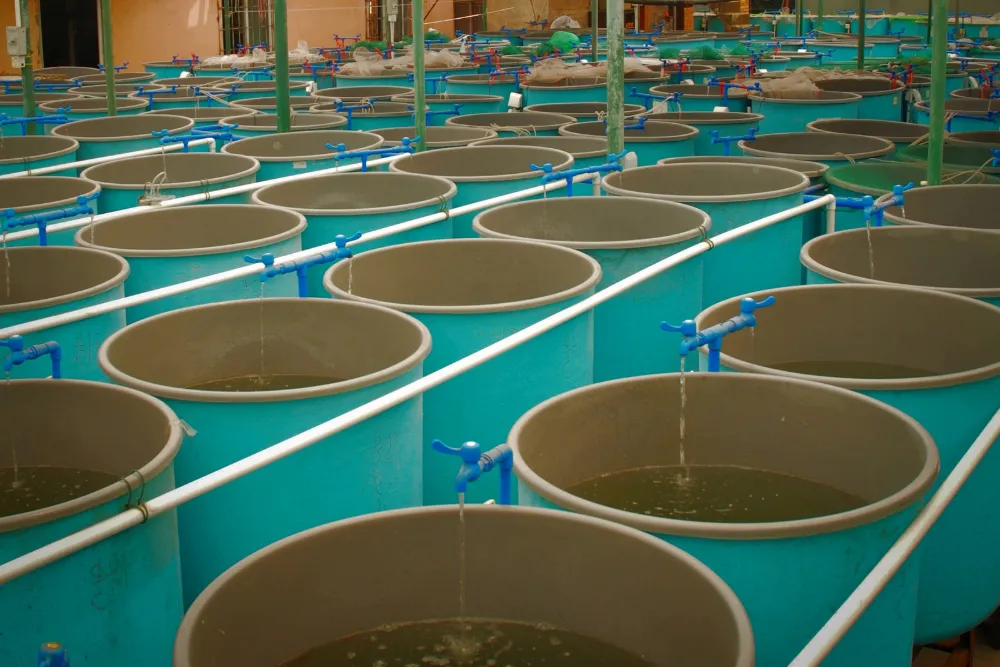
Indoor tanks with piping in an aquaculture facility

Farming systems and applications

In recirculating systems (RAS), biological filtration, water volume and organic load are central. In open or flow-through systems, water temperature, varying inflow and season play a larger part.

In the hatchery and nursery phase, volumes are often small, dosing precise and agreements on use strict. Product form and packaging follow from that.

  • Recirculating systems (RAS)
  • Open and flow-through systems
  • Hatchery and nursery phase

Decision criteria

What determines the product route?

Six points we go through in every aquaculture project.

  • Farming system and water volume

    Recirculating, flow-through or pond, and the size of the system, determine how a product can be applied.

  • Species and stocking

    The species farmed and the stocking density steer the load and the demands on the water.

  • Feed and organic load

    Feeding regime and waste streams determine how much organic material the system handles.

  • Water quality and salinity

    Fresh, brackish or salt water, temperature and pH determine which microorganisms come into consideration.

  • Dosing and application

    The farming system sets how a product is added: recirculating, flow-through and pond systems differ, and so do the form and packaging.

  • Regulation per country and species

    Use in aquaculture can be subject to rules per country and species. We discuss this up front; responsibility stays with the brand owner.

Approach

From first conversation to pilot

We start from your market and farming system.

  1. Discuss market and system

    Which farming systems, species and target group do you want to serve?

  2. Record the technical context

    Water conditions, load, dosing and agreements on use.

  3. Select organisms and formulation

    With our microbiological expertise and strain bank we choose organisms and formulation.

  4. Prepare a pilot batch

    A smaller batch for introduction under your brand, with room to scale up afterwards.

  5. Check quality and deliver

    CFU (colony-forming units) and quality are checked, after which delivery follows.

Frequently asked questions

Briefly answered

Which aquaculture systems can use microbial products?

That depends on system, species and water conditions. We discuss per project whether a product suits recirculating systems, flow-through systems or a nursery phase.

Who decides the application and claims of the product?

The brand owner decides positioning and claims. We discuss up front what is technically and legally relevant for the application.

Next step

A product idea for aquaculture?

Tell us which farming system and market you want to develop for. Then we determine the first route together, including a pilot.